

Brooklyn has some of the most varied and photogenic outdoor settings in New York City, and Prospect Park sits at the center of that.
The Prospect Park wedding photography locations within this 585-acre landscape range from open meadows and wooded ravines to formal structures and lakeside bridges.
Each spot behaves differently depending on the time of day, the season, and the size of the event.
This guide covers the locations I return to most, how I approach each one, and what couples and planners should know before committing to any of them.
Key Takeaways
- Prospect Park has eleven distinct wedding photography locations within walking distance, from formal architecture to wooded ravines.
- The Picnic House is the park’s primary indoor wedding venue, managed through the Prospect Park Alliance and booked separately.
- Elopements and ceremonies require an NYC Parks Department permit; group size determines which permit type applies.
- Early-morning weekday sessions offer the most control over lighting and foot traffic, regardless of the season.
- A documentary approach prioritizes reading the existing light and movement over staging, making familiarity with the location essential.
Best Prospect Park Photo Spots for Weddings
Prospect Park photography works because the park offers density. Within a short walking distance, the environment shifts from open sky to deep shade, from stone architecture to water.
That variety matters when a wedding runs several hours and the light changes multiple times.
Lullwater Bridge
Lullwater Bridge sits near the Boathouse and crosses one of the narrower sections of the lake.
The ironwork and stone construction frame couple well from multiple angles, and the water reflection adds depth to wider shots.
Foot traffic here is consistent throughout the day, so timing matters. Early morning on weekdays gives the most unobstructed access.
Prospect Park Boathouse and Reflecting Pool
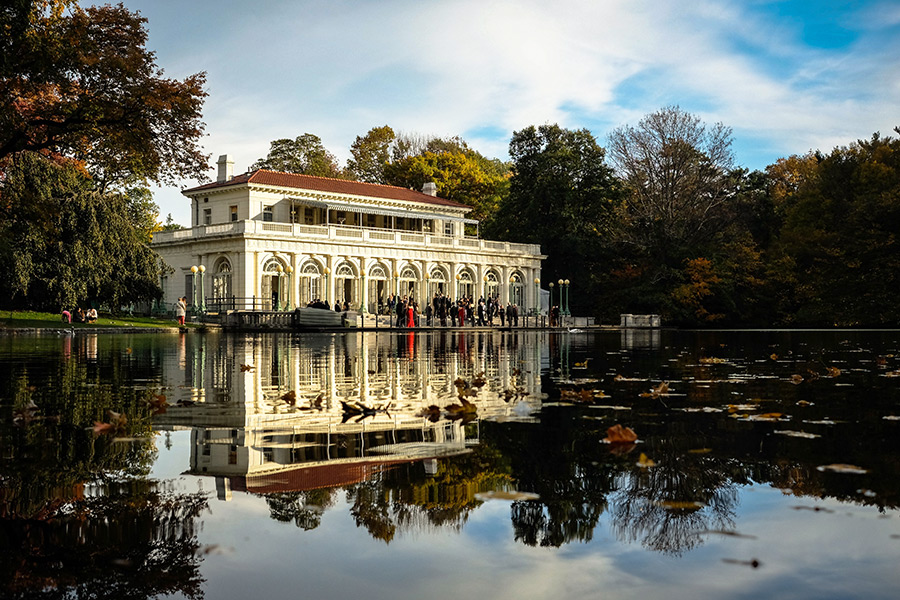
The Boathouse is one of the most recognizable structures in the park. Its Beaux-Arts facade and the still water in front of it create strong compositional lines.
I use the reflecting pool for environmental portraits when the light is even, typically in the hour before sunset.
The surrounding lawn also works well for group coverage after the ceremony, when the couple wants a quieter moment away from guests.
The Peristyle
The Peristyle, also called the Grecian Shelter, sits in the southern section of the park. Its columns provide structural framing without requiring the couple to pose within them.
I tend to work around the columns rather than between them, using the architecture as a background element while keeping the subjects in motion.
The Rustic Arbor
The Rustic Arbor is a log structure, a short walk from Lullwater Bridge.
It accommodates small groups of around twenty people and offers a choice of water view or tree cover, depending on orientation.
The filtered light through the canopy makes it one of the more forgiving spots for exposure consistency.
Chaim Baier Music Island
This island sits off the LeFrak Center and is surrounded by the lake on all sides. In spring and summer, the tree cover is dense, and the light that filters through creates strong contrast patterns.
In autumn, the color shift is significant enough to anchor the entire visual character of a session.
I approach this location with longer lenses when possible to compress the background and isolate the couple within the environment.
The Nethermead
The Nethermead is a wide open meadow in the center of the park.
It gives the most flexibility for larger wedding parties and works well for aerial-perspective compositions.
The open sky means the light is uncontrolled, so I prefer this spot in overcast conditions or during golden hour when the directional light is manageable.
The Ravine
The Ravine is the only forested ravine in Brooklyn and one of the more unusual environments in any urban park.
The stone bridges, dense canopy, and waterfall create a layered scene that requires patience to work correctly.
The light inside the Ravine is low and uneven, which calls for wider apertures and careful metering. It is not a fast-paced shooting environment, but it rewards deliberate coverage.
The Vale of Cashmere
The Vale of Cashmere is a quieter section of the park with a reflecting pool and heavy tree cover.
It sees less foot traffic than the Boathouse area, which makes it useful for elopements or portrait sessions where the couple wants space.
The pool provides a mirroring element that I use selectively depending on the time of day and cloud cover.
Lookout Hill
Lookout Hill Prospect Park is the highest natural point in Brooklyn. The elevated position offers sightlines across the tree canopy that are not available elsewhere in the park.
I use this spot primarily for wide environmental shots in the late afternoon, when the sky is active.
The climb is short, but the position gives a sense of scale that flat ground cannot.
Concert Grove
The Concert Grove area includes statuary, ornamental detail, and waterfront views.
It functions well as a transitional location between the Boathouse and the southern end of the park.
The decorative elements give the images a more editorial quality without requiring additional setup.
Grand Army Plaza
Grand Army Plaza marks the main entrance to the park from Flatbush Avenue.
The Soldiers’ and Sailors’ Memorial Arch is a significant architectural element and provides strong framing for formal portraits.
The surrounding fountain and tree-lined paths extend the coverage options beyond the arch itself.
This location works best when the fountains are running and the trees are in full bloom.
Prospect Park Picnic House Wedding
The Picnic House is a historic brick building on the western edge of the park, overlooking the Long Meadow.
It is one of the most commonly used wedding venues in the park and is managed by the Prospect Park Alliance, the nonprofit organization that maintains and programs the park in partnership with the City of New York.
Venue Cost and What It Covers
The picnic house at Prospect Park’s wedding costs vary by day, season, and event size. Weekend rentals typically run higher than weekday bookings.
The rental fee generally covers the space itself, with catering, staffing, and equipment arranged separately.
Couples should contact the Prospect Park Alliance directly for current pricing, as rates are updated periodically.
Ceremony vs. Reception Photography Conditions
Ceremonies at the Picnic House often take place on the Long Meadow side, where the open field provides a natural backdrop.
The light on that lawn is unfiltered and shifts quickly, so I meter continuously rather than locking a setting.
Receptions move indoors, where the large windows along the south wall bring in diffused natural light during the afternoon.
That transition from indoors and outdoors is one of the more technically demanding aspects of Picnic House coverage.
Indoor-Outdoor Flow and Light
The interior of the Picnic House has high ceilings and a mix of ambient and window light. Flash use depends on the time of day and the couple’s preference.
I default to available light when the window exposure is strong enough, and supplement selectively when the room darkens in the evening.
The flow between the lawn and the interior makes it a functional, versatile venue for documentation.
Prospect Park Elopement: Locations and Logistics
Prospect Park works well for elopements because it offers both accessible and off-path locations within a contained geography.
A couple can move between two or three distinct environments within an hour without leaving the park.
Best Spots for Intimate Ceremonies
The Rustic Arbor, the Vale of Cashmere, and the area around Chaim Baier Music Island are the three spots I return to most for small ceremonies.
Each offers natural enclosure, manageable light, and enough visual character to anchor the images without requiring additional elements.
The Lullwater Bridge works for micro-elopements of five or fewer people, particularly on weekday mornings when foot traffic is minimal.
Permits, Group Size, and Timing
The City of New York requires permits for wedding ceremonies in public parks, including Prospect Park.
Applications are submitted through the NYC Parks Department and typically require several weeks’ advance notice.
Group size affects which locations are feasible. Some spots within the park, including the Boathouse and Picnic House, require separate booking through the Prospect Park Alliance.
Smaller gatherings below a certain threshold may have different permit requirements, and it is worth confirming the current thresholds directly with the relevant agencies before planning.
Prospect Park Photography Tips for Every Season
Spring: Bloom and Soft Light
Spring brings cherry blossoms near the Boathouse and color across the formal garden areas.
The light in April and early May is softer than midsummer and stays usable longer into the evening. Crowds are moderate and build toward the weekends.
Summer: Green Canopy and Open Shade
Summer in the park means dense foliage and strong midday contrast. I avoid open sun between 11 am and 3 pm when shadows are harsh.
The Ravine and wooded sections near the Music Island handle summer light better than the open meadow.
Golden hour in late June and July runs well past 8 pm, significantly extending the usable shooting window.
Fall: Color, Contrast, and Crowd Shifts
Fall is the most visually variable season in the park. Peak color typically arrives in mid to late October, and the shift is fast.
The Nethermead and the Ravine show the most concentrated foliage.
Winter: Stillness and Clean Lines
Winter removes the foliage and changes the visual character of every location. The architectural elements become more prominent, and the sight lines across the lake open up.
Snow days are rare, but they create conditions that work particularly well at the Boathouse and Grand Army Plaza.
Light falls early, so session timing needs to account for a shorter window.
How to Plan Your Prospect Park Photoshoot
Foot Traffic and the Best Times to Shoot
Weekday mornings between 7 am and 10 am are consistently the least crowded. Weekend afternoons, particularly in summer and fall, bring the highest volume of park visitors.
I plan arrival times around the specific location, not just the park in general.
The Boathouse area draws more foot traffic than the Ravine or Vale of Cashmere, even on the same day and time.
Parking, Transit, and Entry Points
Street parking around the park is available but variable. The Q and B trains stop at Prospect Park Station near the Lincoln Road entrance, which provides direct access to the Boathouse, Lullwater Bridge, and Music Island.
The F and G trains serve the 15th Street – Prospect Park stop on the western side near the Picnic House.
For larger groups arriving by car, I recommend a designated meeting point inside the park to avoid losing time at the entrance.
Why Photographers Choose Prospect Park for Weddings
Prospect Park is one of the few places in New York City where a full wedding day can move through multiple distinct environments without leaving a single location.
The park is part of the Heart of Brooklyn, a coalition of major cultural institutions in the borough, and it functions as a living environment rather than a static backdrop.
That quality is what makes it work for documentary-style wedding photography. The park does not need to be arranged. It just needs to be read correctly.